Make tuna and apple a chopped filling rather than a wet pile
Tuna, apple and celery can create a bright lunch filling with several distinct textures. This companion uses California’s public-health tuna-apple salad as its reference. Open that recipe for quantities, then organize the chopping and assembly so the fish, crisp produce and bread remain recognizable at the table.
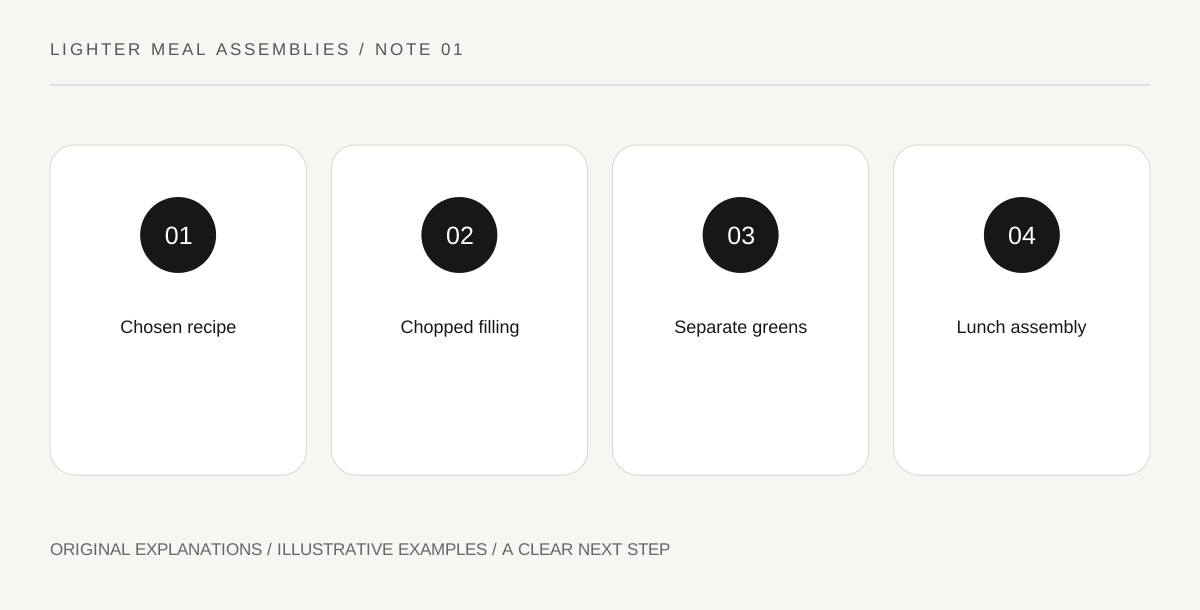
Original explanatory diagram. Read the full method and limitations below.
Choose the reference version deliberately
The CDPH recipe uses drained water-packed tuna, apple, celery, red onion, raisins, Italian dressing, greens and whole-wheat pita. Identify that version before shopping because other tuna-apple recipes use different dressings and proportions. Treat the ingredient list as a coherent starting point. For personal allergy needs or fish-consumption questions, use appropriate professional guidance rather than assuming that a healthy-recipe label makes every ingredient suitable for every person.
Give the chopped pieces a shared scale
Plan apple and celery pieces that can share a bite with flaked tuna instead of leaving one large apple wedge to pull out of the pita. A useful preparation note describes the intended bite: crisp pieces distributed through a filling that can be spooned. This is an original kitchen observation to guide your knife work, not a claim that one precise cube size has been tested. Use a stable surface and safe tools, and prepare produce appropriately before cutting.
Separate filling and greens in the work area
The source mixes the tuna filling and dresses the greens separately before filling the pita. Set out two clearly different bowls so the sequence is easy to follow. This also makes it easier to see whether the apple has been distributed rather than hidden beneath leaves. Do not keep adding dressing simply because the filling looks different from a mayonnaise salad. The intended result has its own texture and does not need to imitate a creamy deli version.
Assemble a lunch you actually want to eat
Use the pita as one serving option rather than a fixed personal diet allowance. Consider what else belongs with the meal for your appetite and circumstances, such as another suitable food or a simple vegetable side. If preparing ahead, keep perishable ingredients appropriately refrigerated and follow relevant cold-transport guidance. A lunch that remains unidentified on a warm desk is not made safe by the absence of mayonnaise. Make the assembly timing part of the plan rather than treating it as an afterthought.
Illustrative worked example
Illustrative lunch plan: A cook chooses the CDPH version and makes the filling pieces small enough to spoon together. They keep greens in a separate bowl during preparation and assemble the pita near eating. Another adult prefers the same filling on a plate with suitable bread alongside. The fictional comparison concerns serving format, not a tested shelf life, a calorie reduction or a promise that either amount will satisfy everyone.
Questions that come up
Must the filling resemble mayonnaise tuna salad?
No. The reference uses Italian dressing and crisp fruit and vegetables. Judge the intended chopped mixture on its own terms.
Is a mayonnaise-free filling safe at room temperature indefinitely?
No. Tuna and other perishable ingredients still require appropriate handling. Dressing choice does not remove time and temperature requirements.
References and scope
These sources support the factual background. Examples and exercises are original illustrative teaching material. References do not imply endorsement.
- CDPH: Tuna apple salad — The identified recipe’s ingredients, sequence and permitted variations.