Organize cabbage rolls around leaves, filling and baking dish
Stuffed cabbage rolls combine a softened leaf wrapper with a filling that has its own cooking requirements. Food Hero’s recipe provides the full process. This companion focuses on organizing that assembly so a cook does not confuse a tender outer leaf with a completely cooked center or discover the dish is too small halfway through rolling.
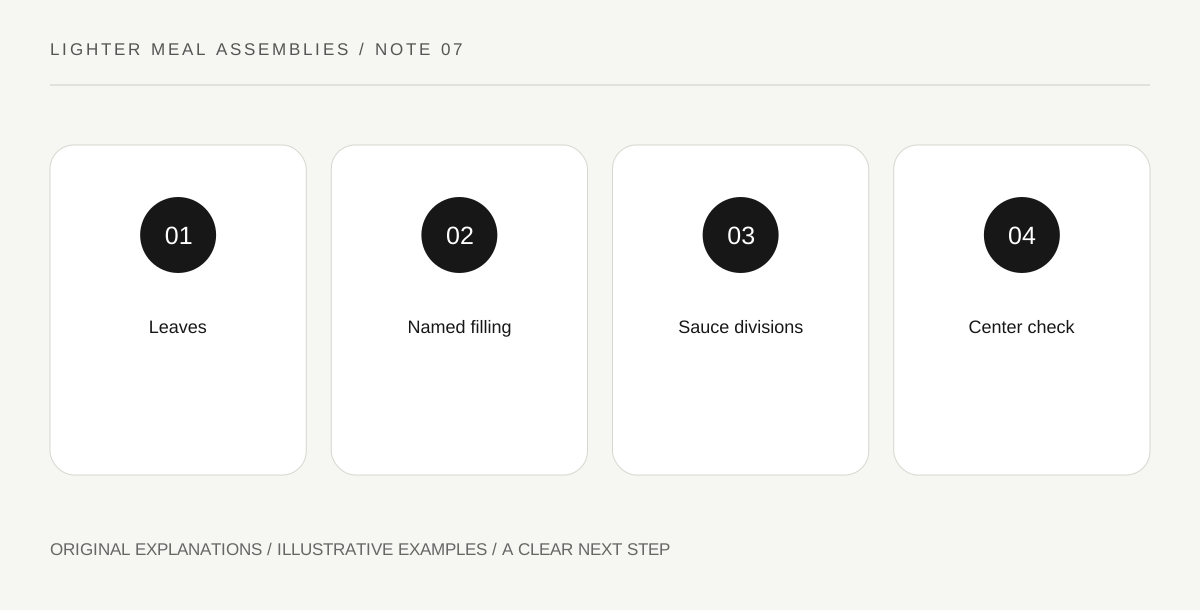
Original explanatory diagram. Read the full method and limitations below.
Count the usable leaves before filling
The source describes preparing leaves and cooling them enough to handle before assembly. Follow its safe method rather than pulling hot leaves apart hurriedly. Lay out the intended wrappers so you can see how many are usable and whether their shape can hold the filling. A leaf with a large tear is a practical assembly problem to resolve before the mixture is divided, not a reason to overfill the remaining leaves to preserve an assumed count.
Name the meat inside the roll
The reference allows several ground meats, while the safe cooking endpoint depends on the actual ingredient. FoodSafety.gov lists 160°F for ground beef or pork and 165°F for poultry; casseroles are listed at 165°F. Use the appropriate complete endpoint for the actual dish, including poultry when chosen, rather than borrowing a lower number from another filling. The center needs an appropriate thermometer check. A browned sauce or soft cabbage wrapper does not establish that the filling is ready.
Plan a consistent assembly task
Food Hero combines the filling with cooked rice and portions it into leaves before rolling and placing the seam downward in the prepared dish. Use the complete recipe for amounts. The original planning question is whether each roll has a manageable shape and whether the dish holds the intended arrangement without a last-minute stack. Avoid treating the number of rolls as a reason to force every scrap into one oversized final parcel. Assembly consistency makes the cooking task easier to understand.
Reserve sauce for its stated stages
The source divides tomato sauce between the dish, filling and top. Put that division on the preparation note before opening the can so the first bowl does not accidentally receive the entire amount. Keep the covered baking method and checks from the full recipe available. At serving, choose companions according to the meal’s needs rather than assuming one roll is a prescribed diet portion. Record the filling type with any saved food so another adult knows what is inside the wrapper.
Illustrative worked example
Illustrative assembly: A cook reads the sauce divisions first, prepares a suitable baking dish and identifies the filling as ground poultry with cooked rice. They keep the correct poultry and casserole endpoint in view and check the center appropriately. A torn leaf is addressed before dividing the filling. The fictional exercise gives no household shortcut for cooking raw filling and no universal number of rolls per person.
Questions that come up
Does a tender leaf prove the center is done?
No. The filling requires its own appropriate cooking check. Use the correct endpoint for the actual meat and dish.
Can I use a beef endpoint when filling with turkey?
No. Poultry requires 165°F, or 74°C. Follow current guidance for the actual dish rather than transferring a lower endpoint from another ingredient.
References and scope
These sources support the factual background. Examples and exercises are original illustrative teaching material. References do not imply endorsement.
- OSU Food Hero: Stuffed cabbage rolls — The identified recipe’s ingredients, sequence and permitted variations.
- FoodSafety.gov: Safe internal temperatures — Poultry 165 F; ground beef/pork 160 F; fish 145 F; egg dishes 160 F; casseroles and reheated leftovers 165 F.