Blend peanut butter into a tomato soup base deliberately
Food Hero’s West African Peanut Soup is a particular extension recipe with a tomato-peanut base and already cooked chicken. Use the full source and identify those starting conditions before cooking. This companion focuses on ingredient staging and the peanut-butter addition without claiming to represent the many distinct food traditions of a whole region.
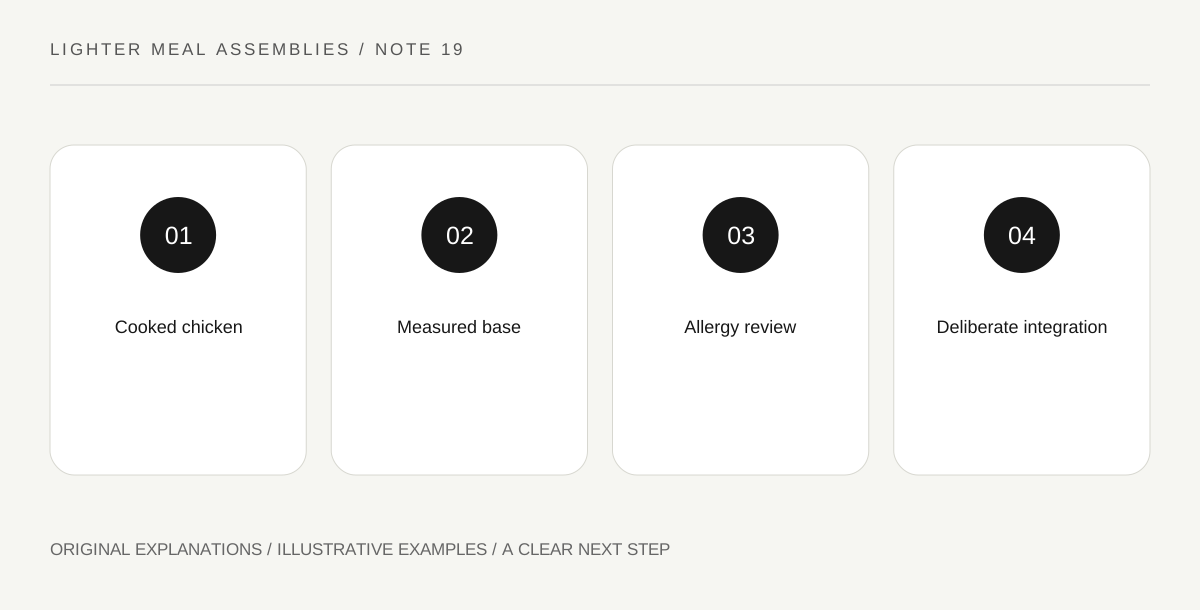
Original explanatory diagram. Read the full method and limitations below.
Read cooked chicken as a required starting state
The source specifies diced cooked chicken. That phrase should remain on the preparation list. Raw chicken is not an unnoticed substitute for a brief heating stage. Use chicken with an appropriate known handling history, and follow current safe preparation or reheating guidance for the actual situation. FoodSafety.gov lists 165°F for poultry and reheated leftovers. If cooking chicken specifically for this dish, give that work its own suitable process before beginning the soup assembly.
Prepare the concentrated ingredients before heating
The reference includes tomato paste, tomatoes, broth, peanut butter and seasonings. Locate and measure them according to the full recipe before the pot needs attention. A jar with only a trace of peanut butter is not the planned ingredient quantity merely because the label matches. The original workflow question is whether all components can be incorporated smoothly without leaving the pot unattended while opening a cupboard or searching for an appropriate utensil.
Keep peanut and sesame identity visible
The source uses peanut butter and sesame oil. These are relevant ingredients for allergy needs; a soup name does not describe every exposure. Read actual labels and individual requirements before preparing food for others. The source offers a sunflower-seed alternative, but changing one ingredient does not automatically resolve every allergy or cross-contact question. Choose a suitable complete plan rather than treating substitution as a universal medical clearance or assuming a creamy texture proves the same ingredients were used.
Use gentle integration as a cooking task
Food Hero stirs the tomato-peanut mixture together and heats it without boiling in its stated method. Follow the complete process while also meeting the appropriate safety requirements for the food’s actual history. Observe whether the concentrated ingredients have dispersed rather than remaining as isolated spoonfuls. Plan suitable companions according to appetite and needs. A note identifying the cooked chicken and nut or seed choice makes a repeat practical, without promising a special nutritional result from the soup’s rich texture.
Illustrative worked example
Illustrative ingredient staging: A cook identifies appropriately prepared cooked chicken, measures the tomato and peanut ingredients and checks household allergy requirements before beginning. They follow the source’s integration method and the appropriate heating endpoint for the actual food history. The meal has suitable additional food as wanted. The fictional scenario does not authorize raw chicken in a short warming step or claim that a seed substitution makes every version allergy-safe.
Questions that come up
Can raw chicken enter wherever cooked chicken is listed?
No. That changes the process. Prepare chicken with an appropriate complete method and endpoint rather than relying on a brief soup-heating stage.
Does replacing peanut butter settle every allergy question?
No. Review the complete ingredients, individual requirements and cross-contact controls. One substitution does not create a universal guarantee.
References and scope
These sources support the factual background. Examples and exercises are original illustrative teaching material. References do not imply endorsement.
- OSU Food Hero: West African peanut soup — The identified recipe’s ingredients, sequence and permitted variations.
- FoodSafety.gov: Safe internal temperatures — Poultry 165 F; ground beef/pork 160 F; fish 145 F; egg dishes 160 F; casseroles and reheated leftovers 165 F.