Make a garden sloppy-joe filling that can be spooned onto a bun
A vegetable-rich sloppy-joe filling is a spoonable mixture, not a dry burger patty. Food Hero’s version combines ground meat with several vegetables and tomato ingredients. Use the complete source recipe and choose the meat deliberately, then observe the filling’s consistency before assembling the open-faced serving.
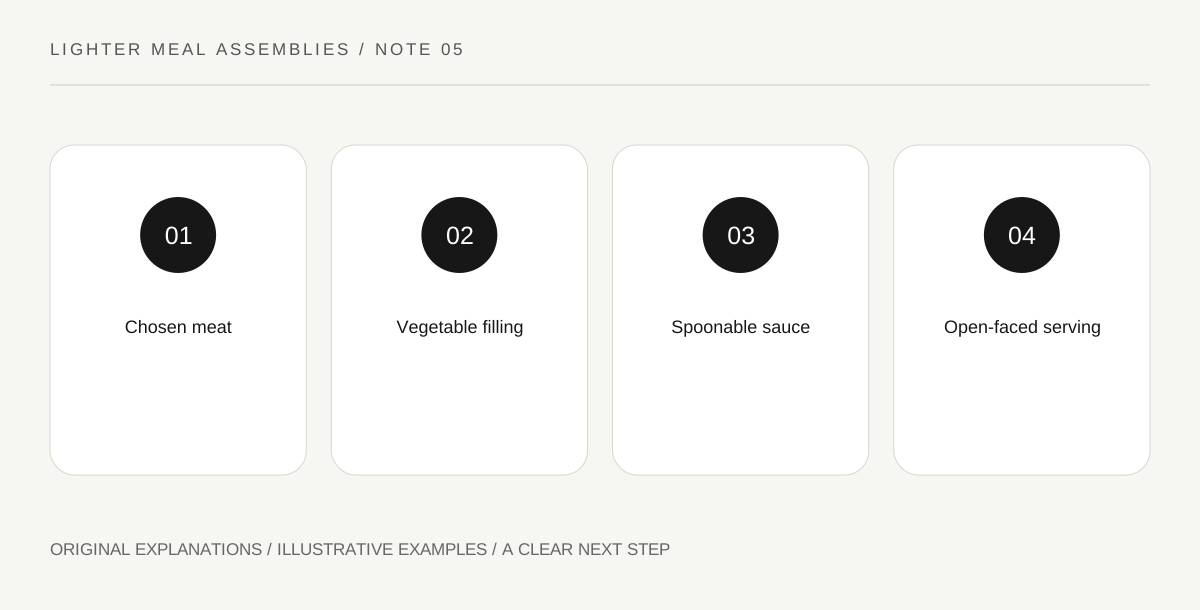
Original explanatory diagram. Read the full method and limitations below.
Name the meat and vegetables separately
The source allows lean ground turkey, chicken or beef, with onion, carrot, pepper, mushrooms and tomato ingredients. Select the actual meat before cooking because its safety endpoint differs by category. FoodSafety.gov lists 160°F for ground beef and 165°F for poultry. Color alone does not establish doneness. Keep the chopped vegetables identifiable on the preparation note so the recipe does not become a mostly-meat sauce merely because the first ingredient was easiest to find.
Use a pan that permits stirring
The filling includes more than the visible ground meat volume. Check the source’s equipment guidance and choose a suitable pan for the complete mixture. A saucepan filled to its rim makes stirring and observing the bottom harder. This is a practical capacity check, not a reason to raise the heat to force all the food through a smaller pan. If scaling, use an appropriate recipe and equipment plan rather than assuming doubled quantities fit the same vessel without consequence.
Distinguish thickening from drying out
Food Hero simmers the combined sauce until thick. The useful serving question is whether the mixture can be spooned onto the bread without immediately flooding the plate. That is different from cooking until the filling becomes dry and catches on the bottom. Follow the recipe and stir as directed. When recording a repeat, describe whether the vegetables remained distinct and the sauce was spoonable instead of writing only that the mixture needed more time, which leaves the intended endpoint unclear.
Give the bun an actual place in the meal
The source serves the filling over bun halves, optionally toasted. Set up that serving arrangement before the pan is ready, using clean utensils after raw-meat handling. Choose any additional suitable food according to appetite and needs rather than treating open-faced presentation as a diet rule. If some filling is saved, preserve its identity as cooked meat-and-vegetable filling with an appropriate handling plan. A container labeled only sauce may obscure what another caregiver needs to know.
Illustrative worked example
Illustrative serving decision: A cook selects ground turkey and uses the appropriate poultry doneness check. They follow the source’s simmering stage and observe whether a spoonful stays on an open bun half. The vegetables remain named in their cooking note, and a separate side is planned. The example is a fictional workflow, not a tested reduced-calorie claim or a guarantee that one bun half constitutes a meal for everyone.
Questions that come up
Can I judge ground poultry only by its color?
No. Use the appropriate food-temperature check. FoodSafety.gov lists 165°F, or 74°C, for poultry.
Does open-faced serving prescribe a smaller diet portion?
No. It is the source’s serving format. Choose the overall meal and amount to fit individual needs rather than treating presentation as a universal restriction.
References and scope
These sources support the factual background. Examples and exercises are original illustrative teaching material. References do not imply endorsement.
- OSU Food Hero: Garden sloppy joes — The identified recipe’s ingredients, sequence and permitted variations.
- FoodSafety.gov: Safe internal temperatures — Poultry 165 F; ground beef/pork 160 F; fish 145 F; egg dishes 160 F; casseroles and reheated leftovers 165 F.